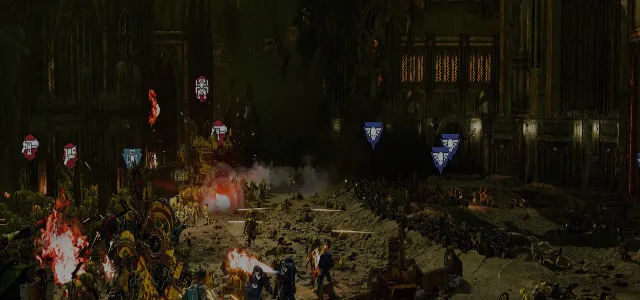
Where this mechanic stands
The publisher’s description of the game, read on its official store listing on 4 September 2026, closes its campaign paragraph on a conditional: when the threat becomes too great, consider unleashing apocalyptic weaponry to erase entire planets from existence. That sentence is published by the publisher. The word Exterminatus is not — it comes from specialist press, which used it in its headline on the day of the announcement, 12 December 2025, and from thirty years of the setting where it is the name for exactly this act. This page keeps the two apart on purpose: the deed is confirmed, the name attached to it is the press applying the setting’s vocabulary.
What the tabletop establishes
In the Warhammer 40,000 setting, Exterminatus is the Imperium’s admission of defeat dressed as a victory. A world is judged beyond saving — corrupted, infested, lost — and it is killed, by virus bomb, by cyclonic torpedo, by whatever is to hand. It is not a weapon of conquest, because there is nothing left to conquer afterwards. It is invoked rarely in the fiction and it is always a scandal when it happens, which is a large part of why it carries weight. Nothing on the tabletop models it: it is a story event, not a rule.
The publisher’s description of the game ends its campaign section with a conditional: when the threat becomes too great, consider unleashing apocalyptic weaponry to erase entire planets from existence. In the setting, Exterminatus is the Imperium’s last resort — a world is judged beyond saving and killed. It is the only thing in the published description that is explicitly irreversible.
Tabletop identity, as established by Games Workshop. It says nothing about the video game.What has actually been shown
The published sentence carries two qualifiers that are easy to read past, and both are doing work. The first is conditional — when the threat becomes too great — which frames the act as a response to losing rather than a tool for winning. The second is the verb consider, which is unusual in marketing copy about a feature and suggests a cost that a player would weigh rather than an option they would take freely. What that cost is has not been published. Nor has who may do it: three of the four announced factions are not the Imperium, and the setting gives them no equivalent doctrine.
What to watch next
The open question is whether a Total War campaign map can survive having a piece of itself permanently deleted. Every campaign in this series is built on capture: a settlement changes hands, is razed, is rebuilt, changes hands again, and the map keeps its shape for the whole game. Razing is destructive but it is never final. A world erased from existence is a node gone from the map for the rest of the campaign — the first genuinely irreversible act the series would have ever offered, and the first time the map itself becomes something a player can spend. That raises questions nobody has answered: whether the AI can do it to a world you own, whether it can be done to a faction’s last holding and so end them outright, and whether a campaign that has run long enough ends on a map with holes in it. The publisher has published one sentence and no rules. Information correct as of 4 September 2026.
What is not known
These questions have no published answer as of 4 September 2026. They are listed because an absence of information is information — and because we would rather name the gap than fill it.