Where this mechanic stands
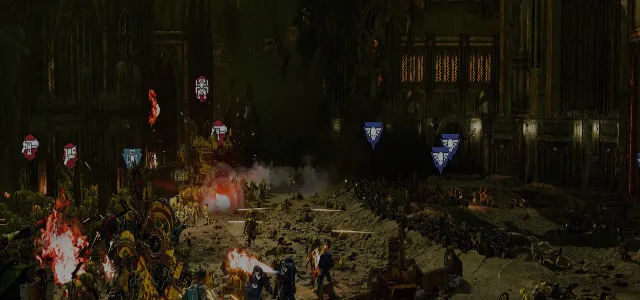
The publisher’s own description of the game, read on its official store listing on 4 September 2026, lists bombarding enemies from orbit among the things the player does — in the same sentence as conquering and developing strongholds and deploying armies to the ground. The same clause appeared in specialist coverage of the announcement of 12 December 2025, so this is not a recent addition. That single clause is the entire published basis of this page. No rule, no cost, no cooldown and no restriction has been described by anyone, and no footage released to date has been reported as showing an orbital bombardment being used.
What the tabletop establishes
Orbital bombardment has no ancestor in this series, and that is the point worth making first. Every Total War is built on two layers that do not touch: a turn-based campaign where armies move, and a real-time battle where the armies that met each other fight it out. Artillery exists, but it is artillery that walked to the battle inside your army. Nothing has ever been fired into a Total War battle from outside it. On the tabletop the equivalent does exist and it is deliberately awkward — an off-board asset paid for before the game, aimed at a point of the table, resolved once. It is powerful precisely because it does not belong to either army on the board.
The publisher’s own description of the game lists bombarding enemies from orbit among the things you do, in the same sentence as conquering strongholds and deploying armies to the ground. On the tabletop, orbital bombardment is an off-board asset: something bought before the game that lands on a chosen point of the table. What a Total War does with a weapon that belongs to neither of its two layers has never been answered, because no Total War has ever had one.
Tabletop identity, as established by Games Workshop. It says nothing about the video game.What has actually been shown
What the publisher has published is a verb, in a list of verbs. It is worth being exact about where the clause sits, because that is the only structural information available: it appears in the campaign paragraph, between conquering strongholds and deploying armies to the ground, which reads as a campaign-layer action rather than a battlefield ability. That reading is an inference from sentence order and this page does not present it as anything more. Nobody outside the studio has described what the action targets, what it costs, how often it can be done, or what it leaves behind on the world it hits.
What to watch next
The open question is which of the two layers this weapon lives on, and it is not a detail — it decides what kind of game this is. If bombardment is a campaign action that softens a world before you land, it is an economy of preparation, and the battle you eventually fight is still a fair contest between the two armies present. If it can be called down during a real-time battle, then for the first time in the series something outside the battlefield can decide a battle, and every assumption about reading a Total War engagement from the deployment screen stops holding. The setting strongly favours the second reading; the sentence structure of the only published source weakly favours the first. Neither is evidence. Until the publisher describes the action rather than naming it, the honest answer is that the game has confirmed a weapon and confirmed nothing about how it is used. Information correct as of 4 September 2026.
What is not known
These questions have no published answer as of 4 September 2026. They are listed because an absence of information is information — and because we would rather name the gap than fill it.