Where this mechanic stands
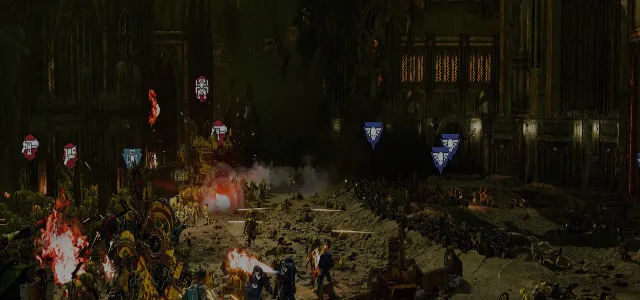
This is one of the better-sourced features of the game, and unusually it is documented from three directions. The publisher’s own description, read on its official store listing on 4 September 2026, promises battles featuring dynamic destruction and states that every impact reshapes the terrain, creating new cover and fresh tactical opportunities. PC Gamer, reporting on the reveal broadcast of 1 May 2026, attributes to the studio’s battle product owner Dave Petry the plainer version: that forest, if you don’t like it, you don’t have to keep it. PCGamesN, reporting on 12 July 2026 on the narrated demonstration shown at BiliBili World in Shanghai, quotes the narration describing many different buildings and objects that can be destroyed, opening up new tactics, routes and strategies.
What the tabletop establishes
Terrain in a Total War battle is a contract. You are shown the ground before deployment, you read it — the ridge, the wood, the choke point, the ford — and you commit an army to a plan that the ground will still support twenty minutes later. Buildings can be fought over and set alight in some titles, but the shape of the field does not change. On the tabletop the contract is even stricter: scenery is placed before the first turn and stays exactly where it was placed until the game ends. Neither tradition prepares a player for ground that is being edited while they fight on it.
The publisher’s description of the game promises battles across worlds featuring distinct biomes, battlefield types and dynamic destruction, and adds that every impact reshapes the terrain, creating new cover. Press reporting on the reveal broadcast quotes the studio’s battle product owner on the same point, in plainer words: that forest, if you don’t like it, you don’t have to keep it. On the tabletop, terrain is placed before the game starts and stays where it is.
Tabletop identity, as established by Games Workshop. It says nothing about the video game.What has actually been shown
Three sources agree that scenery can be destroyed, and none of them describes a rule. That distinction matters more here than on most pages, because destruction is the kind of feature that spans an enormous range while sounding identical in every description of it. It could mean scripted set pieces on particular maps, a physical simulation applied to most objects, or something in between where certain classes of scenery have hit points. The publisher’s wording — every impact reshapes the terrain — is the most expansive of the three, and it is also marketing copy, which is exactly the sort of sentence this site refuses to treat as a specification.
What to watch next
The open question is what destructible ground does to the one thing this game has that no previous Total War has: cover. The publisher’s sentence links them directly — impacts create new cover — which is a much stranger claim than it first appears. It means the amount of protection on a battlefield is not fixed at the start, and that a ruined building may be worth more as rubble than it was as a building. Read the other way round, it also means cover can be taken away: a line holding a wood is holding a wood that the enemy can delete. That is a kind of decision Total War has never asked a player to make, and it is the sort of thing that either transforms the series’ battles or turns out to be scenery. Nothing published settles which. Information correct as of 4 September 2026.
What is not known
These questions have no published answer as of 4 September 2026. They are listed because an absence of information is information — and because we would rather name the gap than fill it.